Saturday, March 3, 2012

Customize your Bookmarks Bar

Don't know what a bookmark bar is? Well, you're in the right place. In this post I'll explain what it is, how to enable it, and how to customize it in your Google Chrome browser. (If you're a Firefox user, click HERE for information.)

What is a Bookmark Bar?
Basically, it is a bar below your URL toolbar which stores your favorite sites. One click takes you to the sites you've saved. You can also drag and drop a site onto the bookmark bar.

What First?
First, you need to enable it, by clicking on your 'Customize and Control Google Chrome' icon in the top right corner of your browser. Click Bookmarks then choose Show Bookmarks Bar.

You may be given the opportunity to import bookmarks from another browser. You can do that if you choose, or start from scratch by simply going to your favorite sites, clicking their favicon (little picture beside their web address), and dragging it down to your bookmark bar.

Customizing:

Editing Titles: You might notice that when you first enable your bookmark bar, it shows the favicon as well as the title of the website. This takes up a lot of space, and is generally not needed. Here's how to fix it so that only the icons or specified text shows up. Just right click on the favicon on your bookmark bar. Click Edit. Now you can delete the name, or give it a few letters so it won't take up so much space on your bar. Repeat as necessary. 

Rearranging Favicons: Favicons can be rearranged by dragging and dropping them into place. You can even separate them into groups by renaming the last favicon in the group with a period or slash mark. 

If you'd like to add a favicon to your own blog, please see Cara's post at Teaching My Calling.

Wednesday, February 29, 2012

Seuss-errific Reading!

I found this fantastic hat template the other day at A Teacher's Treasure and couldn't wait to use it with my class! Of course, I changed it up a little to fit with the skill we've  been working on all week--Author's Purpose. See my Horton and Lorax posts for more on those lessons). They include pictures of anchor charts, student samples, and links to the documents I made to go with the lessons. 


In today's lesson, I wanted to lower the scaffold even more, so I read Thidwick the Big-Hearted Moose to the class, then had the students create these awesome foldables. The task was to listen during the story and identify examples of when the author was informing, persuading, entertaining, and expressing ideas. They jotted down those examples on their 4-square papers from this lesson, then after the story, they wrote their items under each flap of the foldable. The top flap was where they were supposed to write what they thought the author's main message was. Here are a few of the examples from today:


This one says, "Don't be a free-loader!" was his main message. Love it!

Tuesday, February 28, 2012

The Backwards Zorro

Are you teaching your kiddos how to solve fraction of a group problems? My co-worker came up with a fabulous name for the tried and true strategy that we probably all use: The Backwards Zorro! It's visual and fun to say and it really seemed to stick in the minds of the kiddos. Here's how it works:
Starting at the bottom, draw a line from the 4 to the 24 (4 goes into 24 six times). Draw the line to the 3 (six times three is 18). Draw the top line and write the answer. Presto!

Author's Purpose with Horton

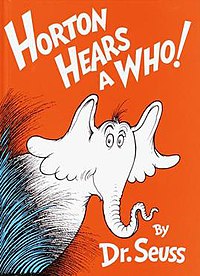
After this really great Author's Purpose with The Lorax lesson yesterday, I decided to go a step further today using Horton Hears a Who! I think my kiddos are finally starting to understand that Author's Purpose is about more than those four words (persuade, inform, entertain, express).

In today's lesson I challenged them to listen and look for things the author included in the text and infer why he did that. Here's a copy of our anchor chart from the lesson:
What was so great is that even though I was modeling and sharing my thoughts as we went along, the kiddos made so many great inferences and thought of so many things that I'd never even considered! Here are a few of their papers:
Here's a copy of the chart I made for the kids to use if you're interested.

At the end of the lesson, I had the students use the back of the chart and follow the same procedure in whatever book they happened to be reading during Read to Self. Great formative assessment. I could really see who was able to apply the strategy and who needed more instruction.

Monday, February 27, 2012

Seuss-tastic Hats!


Last Friday's art activity: Create a tissue paper hat! I love the fact that every single hat is different. The kiddos were told that they could make a traditional red and white hat or their own design.

Author's Purpose with The Lorax

 
You know those lessons that are just right on target and everything goes well and you never want to forget how you taught them? I had one of those today, so I just HAVE to blog about it. 
First, you should know that my class is having a bit of a problem with Author's Purpose (according to their Scott Foresman unit benchmarks). I'm not talking about just determining an overall purpose for writing such as persuade, entertain, or inform. Our program wants students to infer even more and determine the author's purpose for specific sentences, etc...That's the hard part. My kiddos just couldn't seem to understand that author's purpose is about more than those broad reasons. Our reading coach suggested that maybe they weren't making the connection and if we charted specific examples it might help them make the transition. So, here's what I did:
  • First, we reviewed Author's Purpose (4 things in Scott Foresman): Persuade, Inform, Entertain, and Express Ideas (which includes descriptions).
  • Then we used the Carousel charting strategy. I made four posters on large chart paper. At the top of each paper was this question: What words, phrases, or graphic sources would you expect to see if the author is trying to persuade? I changed the underlined word to entertain, inform, and express for the other three charts. The students were divided into four groups and given markers. Each group held a silent conversation at their chart, writing responses rather than saying them aloud. After a few minutes, the groups rotated, so each group was able to visit each chart.
  • After this exercise, we viewed the charts together and discussed. (This allowed me to see what they really knew before we began the lesson).
  • Next, I told the children that we were going to think even more deeply about author's purpose. I told them that I wanted them to read to find specific examples in the text when Dr. Seuss was informing, entertaining, persuading, or expressing ideas. I gave them a copy of this chart (blank when we started):
  • Of course, I modeled heavily in the beginning. I read a page or two then thought aloud about different words, pictures, and phrases and why I thought he used them. We added them to our class chart, and students added them to their personal charts. 
  • After modeling several examples, I read a few pages and had the students work with partners to jot down specific examples, then share with the class. We repeated this several times until we finished the book.
  • At the end of the lesson, I had students return to the four charts and add anything they thought should be added. Then they answered a writing prompt from Minds in Bloom about what they would do if they had the last Truffula seed. 


What was so great about this lesson is that is was multi-level without me having to do a lot of differentiation. The kiddos who were able to think at a higher level and infer deeper meanings weren't held back. They had the freedom to jot and think on their own level. The ones who needed support had the scaffold of talking with their partners.

Another thing that was great is that at first, as a class we predicted that there would be no information in the text since it was a fiction story. The students, however, at the end of the lesson decided that we should put that the Once-ler told what would happen to the environment if it wasn't taken care of in the Information square.


I was able to pull in so many things as we read---onomatopoeia, rhyming words, similes, poetic license, conservation, theme, persuasive techniques...we even talked about how we could use these same strategies in our own writing. Best of all, I think they finally see that Author's Purpose is more than P.I.E.E.


Here's a copy of the chart I made if you're interested:
Author's Purpose Chart

Stay tuned for tomorrow's installment when we take it to the next level...

Wednesday, February 22, 2012

I'm Cool Thanks to Google

So during today's tech session with my 4th graders, I find out that I'm cool...well, technically they said that Google Docs was cool, but since I'm the one that introduced them to Google Docs, I'm thinking that I'm cool by proxy. 

This was such a simple project, but the kiddos just raved about it! First I created a FREE account for our class on Google. Then I showed the kiddos how to log in and create a Google Doc. All they had to do was rename their document to their name (so we could tell whose was whose), then create a 3x2 table. One column of the table was for Amphibians, one column for Reptiles, and one for Both. Finally, they had to research reptiles and amphibians and add facts to their charts.

And don't you love it when you show them a plain, boring, black and white example, and they go all out to personalize their text by changing colors, backgrounds, and fonts? I love it!

These aren't finished, but here are a few that they started today.  

I never thought that they would enjoy this as much as they did. You just never know what will appeal to different groups.

The rest of the plan is to teach them how to create a link in their blog posts to their docs...Can't wait to see how that goes.

Success!

Today we had not one, but two lessons involving rubber bands---no slingshots, no injuries, no disasters. Sometimes its the little things...

Tuesday, February 21, 2012

Not Enough of Me to Go Around


Today I was blessed to welcome my 26th student into my room. I'm not being sarcastic. I really do love each one and know I would miss them dearly if they weren't part of my class. But with this many blessings, comes worry...how can I possibly meet all their needs? There is ONE of me and 26 of them.

How can I possibly deliver instruction suitable for each one? Within my time restraints and curriculum demands (and let's not forget the demands of NCLB), it is impossible difficult to give each student the time and instruction they need in the way that they need it.

I see three hands raised asking for help while I crouch beside the desk of the first child I could get to. As I make my way to the other three students one by one, still more need help. My frustration is not that I can't keep up--its that they are having to wait so long for the help they need! Sure, we do peer helpers and all that, and students know how to help themselves, but usually the hands go up AFTER those things have already been tried.

I just worry that there's not enough ME to go around. All I can do is try each day to meet the needs in front of me and hope and pray that my best is enough.